Keith Shetler, an archery enthusiast, designed Tuning Forks to correct bow limb alignment errors caused by parallax effect. With Xometry's injection molding, he produced 13% glass-filled nylon parts in dark blue, withstanding temperatures from 32°F to 400°F and flexing across 40-50mm bow widths. The final cost was a fraction of 3D printing, enabling a successful Kickstarter campaign.
Industry
Sports
Country

United States
Use case
High-Volume Manufacturing
Technology
Injection Moulding
Materials
13% Glass-Filled Nylon
Product
Tuning Forks™
Xometry's modern design and updated web integration is an indication that the company is thinking about the customer. Xometry is investing in technology to make customers’ lives easier and to make the process faster.
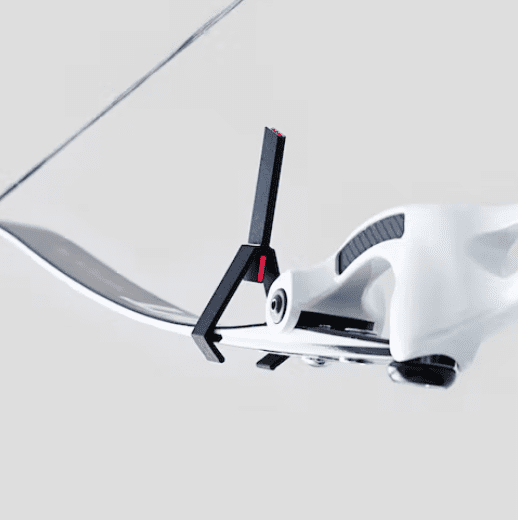
Five years ago, Massachusetts-based hobbyist archer, Keith Shetler, set out to find a way to calibrate a bow’s limb alignment more precisely. He had the idea of creating a tool that would verify a string was in the 3-dimensional center of the bow. Since the tool assists with bow tuning and looks like the musical tool of the same name, he called the pair of tools Tuning Forks™. This tool would solve a problem many archers face: if the string, riser, and limbs of a bow are not properly aligned, even the best archers will find themselves missing their mark with their tuning.
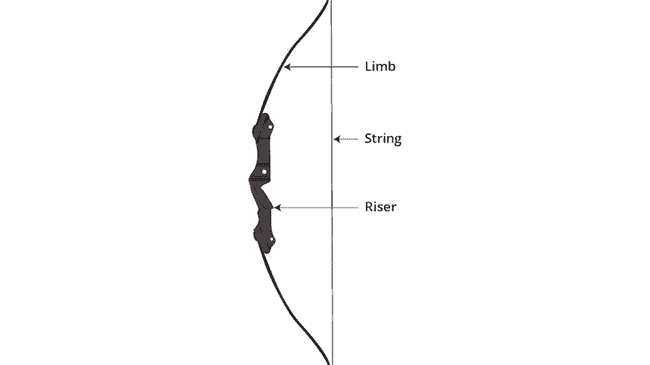
Basic archery bow anatomy
Although it may sound simple to line a string up with the center of a bow, there is more to alignment than what meets the eye. In fact, it is the eyes that estimate string placement based on the perception of two points. Many archers use masking tape to place pen dots on the center of the limbs to help them align their string, but this method is subject to skewing due to the parallax effect.
The parallax effect is the apparent movement of objects because of the observer’s change in position. In the case of archery, simply closing one eye or changing one’s grip on a bow may cause a 2D guiding point to jump to the right or left. Relying just on their eyes, archers can unintentionally introduce a minuscule limb twist of mere degrees, an error which is then magnified over the course of a 70-meter, Olympic standard shot. Additionally, with many adjustable parts on a bow, it may not arrive properly calibrated by the seller.
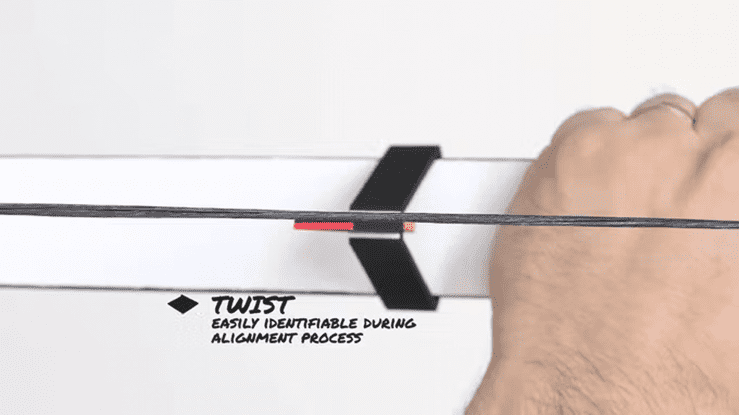
A demonstration of a bow twist. Media courtesy of Earlyhuman, LLC.
Eliminating bow alignment errors can help an archer speed up the tuning process. When they can tune quickly and intuitively, archers can shoot quickly and become confident in their equipment. As a result, a well-tuned bow leads to greater shot consistency.
Keith got to work creating his alignment tool. With the help of free CAD software for hobbyists, Fusion 360, he designed Tuning Forks to attach to the upper and lower bow limbs and protrude out towards the archer. By providing a 3D, instead of 2D, reference to the center of the limbs, the bow attachments would reveal the real center of the limbs—the limbplane. Seeing the limbplane would also help archers correct errors in visual perception caused by the parallax effect. Since the dots would now shift according to limb movement and not the archer’s own positioning, any misalignment would be obvious and quickly correctable.
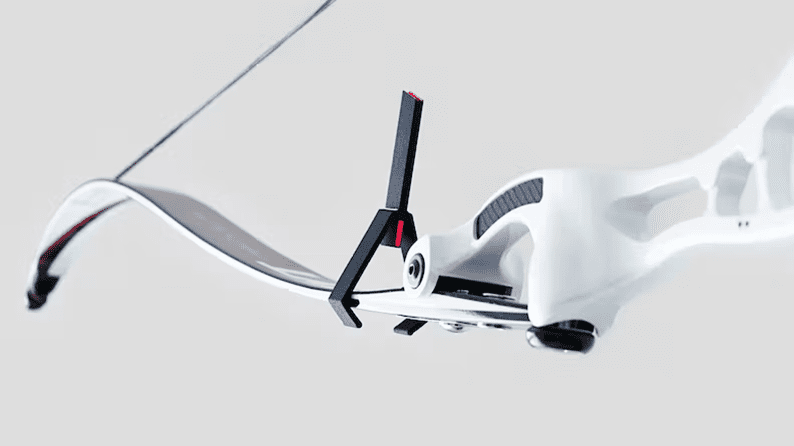
One of two Tuning Forks attached to a bow’s upper limb. Image courtesy of Earlyhuman, LLC.
After Keith began iterating with 3D printing, he gradually reached a relatively static point in his design phase. He gathered interest in his invention in an archery forum and discovered a high demand, especially because there weren’t (and still aren’t) any archery tools of its kind on the market. Keith launched a Kickstarter campaign, successfully raised over $13,000 from 245 backers, and gave a name to his business venture: Earlyhuman, LLC.
Now Keith was ready to move to production. He knew he’d have to explore other manufacturing technologies since no 3D printing process—not fused deposition modeling, not selective laser sintering, not binder jetting—could meet his product requirements.
He had set the market value of his Tuning Forks at $29 per pair and had marketed his Kickstarter campaign accordingly. However, with 3D printing, the minimum production costs would be about $30 a pair, which wouldn’t allow Keith to produce the carrying case or decorate the forks, much less turn any profit. Additionally, Keith needed a surface finish that was much finer and nonporous so he could apply color finishing.
Weighing considerations of cost and quality in mind, Keith shopped around for a manufacturer who could execute short production runs and finally settled on Xometry. Keith had successfully 3D printed SLS prototypes with Xometry before and was drawn to their Instant Quoting Engine℠’s ease of use.
"Xometry's modern design and updated web integration is an indication that the company is thinking about the customer. Xometry is investing in technology to make customers’ lives easier and to make the process faster.”
Keith Shetler, Founder and Owner of Earlyhuman, LLC
He had also enjoyed watching Xometry applications engineers conduct experiments and discuss design-for-manufacturability methods in Xometry’s engineering videos, so he reached out.
When he began talking to the sales and applications engineering team, Keith leaned on Xometry for help, since, of course, he was a video game software developer and marketer by training. “I work digitally—that’s my domain—so this was my first project trying to make something physical and I had a lot to learn.”
Once he explained his project goals, the Xometry team and Keith settled on injection molding as the best manufacturing option. With injection molding, his parts were quoted at a much lower unit cost, even with the cost of tooling. This left money for accessories and to turn a potential profit for his hard work. “Given the estimated market value of Tuning Forks, it made the most sense to do injection molding over any other method.” Additionally, the ability to scale up production in the future and produce a repeatable design with uniform and tight tolerances reinforced injection molding as the best option.
Various manufacturing considerations arose as they began optimizing Keith’s designs: Tuning Forks needed to withstand temperatures as low as 40 degrees to allow for tuning outside in cooler temperatures, and up to 300 degrees so Keith could cure surface decorations onto the parts (and withstand the heat of a summer car interior). He also needed Tuning Forks to withstand pulling, bending, and tumbling during use and transportation.
For the first sample run, often called T1’s, the team added coring and, since there was a chance of warpage on the legs of the tool, they decided to run the samples to determine the amount of warpage. The Xometry team soon found out the amount of compensation needed for warpage, so for T2’s they fine-tuned the part measurements. They also made sure the parts could flex along a large range of bow widths from 40 to 50 mm and added radii to the arms to give the part added stability.
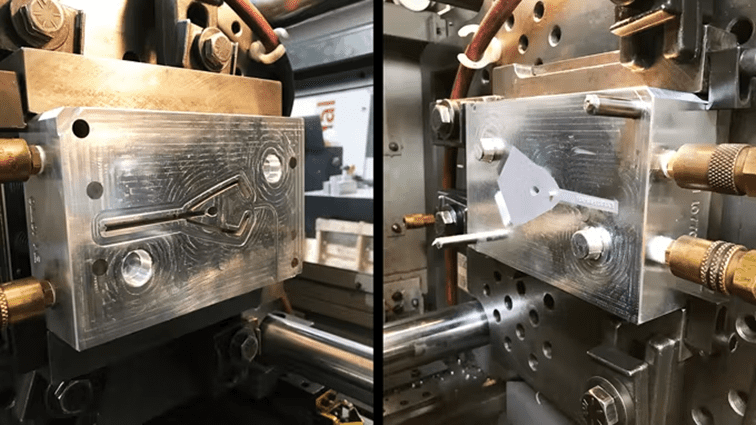
Final mold tool for Tuning Forks. Image courtesy of Earlyhuman, LLC.
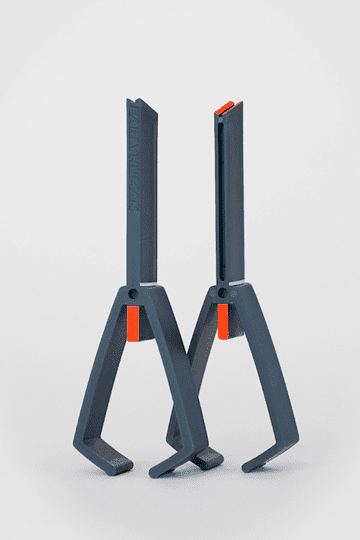
The final Tuning Forks, at 115 mm tall and 40 mm wide and manufactured from dark blue, 13% glass-filled nylon, arrived at Keith’s doorstep in late January 2019. He found that Tuning Forks were durable enough to withstand rough use, ductile enough to snap onto a range of bow sizes, and would withstand a range of temperature from 32 to 400 degrees. The final cost was a fraction of what 3D printing the parts would have cost, especially over the full tool lifetime.
Most importantly for Kickstarter backers, the tool works. Tuning Forks provide the ease of use they were designed for. World class archers including Crystal Gauvin tested early prototypes: “I got the opportunity to put them on my bow at indoor nationals this year and I was blown away by the ease of use, but more importantly the ability to get a truly three-dimensional view of my limb alignment.”
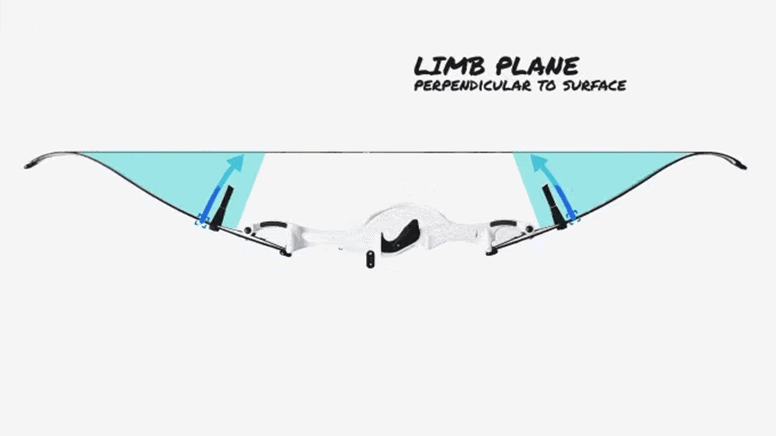
Correct limbplane alignment enabled by Tuning Forks. Media courtesy of Earlyhuman, LLC.
Earlyhuman’s Tuning Forks also help reduce limb oscillation—and, therefore, vibration and noise—by 18%. For beginner archers, this might also help reduce the effect of string slaps from bad form and the subsequent forearm bruising known as the “archer’s tattoo.”
Tuning Forks™, although a simple tool, solve a complex problem. Archers and coaches can now set the alignment of their bows clearly and easily, reducing perception errors and helping them gain confidence in their equipment. This can lead to greater shot predictability and accuracy. At the culmination of five years of work and nearly 30 iterations, Keith achieved the goal he once only dreamed of.
Keith is happy he chose Xometry for injection molding. Knowing the mold is his to keep for its lifetime and that he can scale up production in the future gives him peace of mind. Keith plans to use the mold for its full lifetime of 5,000 parts and is on track to do so, with Tuning Fork requests from more customers and interest from major archery suppliers and stores.
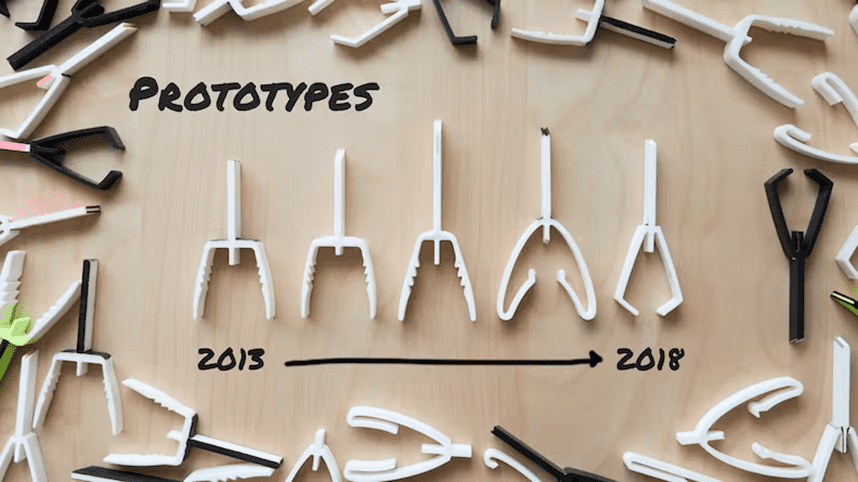
Five major prototypes spanning 2013 to 2018. Image courtesy of Earlyhuman, LLC.


Xometry Triathlon Athlete Partnership: Breaking Standardization Barriers for Custom‑Built Components
Sports
CNC Machining
Prototyping
Read Story
Mr. Liang explained that after upgrading his handlebar extensions, mainstream stock bike frames failed to deliver his ideal reach measurement, a critical riding parameter. Shifting the seat position to compensate would compromise pedaling efficiency and alter his entire bike‑fitting data set. Ultimately, he decided to design a custom reach base mount precisely engineered to match his biomechanical requirements.
Read Story


High-end bike frames produced with the help of on-demand manufacturing
Sports
CNC Machining
High-Volume Manufacturing
Read Story
Kieran founded Radical All Mountain Cycles in 2020, producing the Chilli Dog steel frame for the enduro market. After shifting manufacturing from Taiwan to UK and Germany to address supply chain issues, he used Xometry's CNC machining to produce steel yokes. The yoke increases tire clearance, prevents rear end twisting, and improves energy transfer compared to welded tube designs.
Read Story
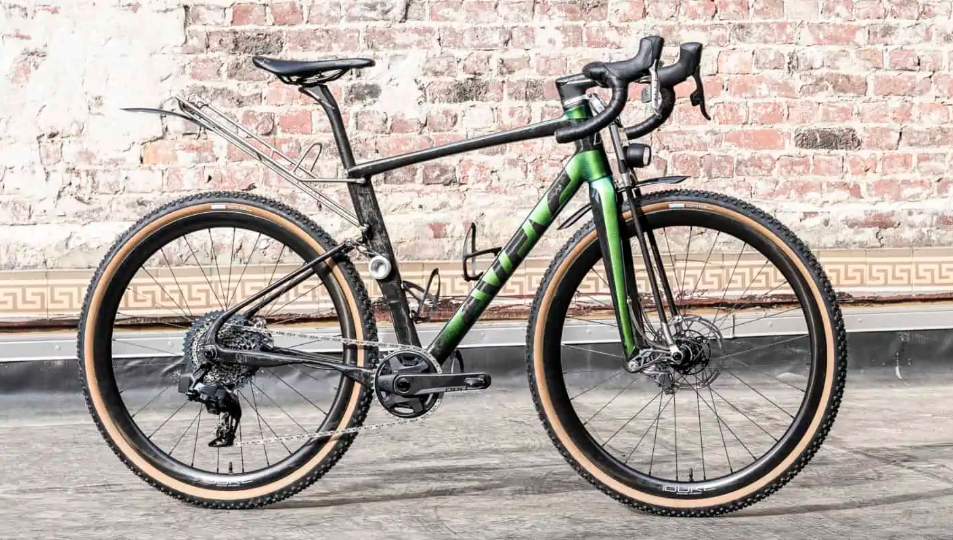

An Innovative Bike With 3d Printed Metal Suspension From Xometry
Sports
3D Printing
CNC Machining
Prototyping, R&D
Read Story
Having a partner we could rely and deliver high-quality parts was essential… If things had gone wrong, we wouldn’t have won the competition.
Read Story

Xometry’s Injection Molding Service Helps Inventor Improve Daily Life for People With Disabilities
Healthcare
Injection Moulding
Prototyping
Read Story
Xometry’s fast quoting, expert design for manufacturability (DFM) feedback, and competitive pricing helped Make Life Easy bring its Easy Hang wheelchair accessory to market.
Read Story

Hardware and Software Integration: Nexusera Joins Hands with Xometry to Improve Patient Medication Adherence
Healthcare
Injection Moulding
Prototyping
Read Story
“Initially, we only needed 1,000 units of the PillCap Smart Pill Bottle. Many manufacturers turned us down due to the small order volume, let alone supporting our POC validation. We found the perfect fit with Xometry. Its on-demand manufacturing model supports custom production starting from just one piece, delivering the flexibility we needed and perfectly matching our fast-paced development timeline.”
Read Story

Facedip: Cooling Down Skincare with Xometry’s Manufacturing Expertise
Consumer Goods
Healthcare
3D Printing
Injection Moulding
High-Volume Manufacturing
Read Story
Xometry is the company that made it the easiest. I talked to a few different companies, and Xometry felt like the best fit for me. A lot of these decisions do come down to who do I want to work with long term, so who do I get the best feeling from and who feels like they understand the product and are excited about it and want to be involved as well.
Read Story


VideoBook to store and share memories & experiences developed using on-demand injection moulding services
Consumer Goods
Injection Moulding
High-Volume Manufacturing
Read Story
We find the concept of on-demand manufacturing that Xometry offers highly useful and believe it fills an increasing need, especially in a fast-paced world like the one we live in. For our part, it lets us keep up with the tight schedule we’re working to and quickly adapt to potential changes and large order batches coming up.
Read Story

The Most Realistic and Lovable Robot Dog is Here
Robotics
Consumer Goods
3D Printing
CNC Machining
Injection Moulding
Prototyping, R&D
Read Story
We essentially needed the dog to be able to complete a series of organic motions like run, jump, and gently collapse, as a puppy might into the lap of its owner.
Read Story

Ryvid Anthem电动自行车通过Xometry择幂科技的制造服务进行生产
Automotive
E-Mobility
CNC Machining
Sheet Metal
Injection Moulding
Die Casting
High-Volume Manufacturing
Read Story
使用 Xometry 择幂科技的首要好处绝对是速度。我们在中国拥有庞大的供应商网络,这也存在自身挑战。我们必须管理供应商,并花费大量时间进行项目管理、质量控制和解决沟通问题。当我们接触 Xometry 择幂科技时,我们发现他们提供了很大的灵活性,特别是在我们的模具工具方面。与真正了解工程和设计的合作伙伴——Xometry 择幂科技沟通,对我们很有帮助。他们的质量和速度表现,对需要今年推出产品的我们来说非常重要。
Read Story

Using Injection Molding to Fight Back Against An Invasive Species
Consumer Goods
Electronic
Injection Moulding
High-Volume Manufacturing
Read Story
This was the largest investment our company had ever made and Xometry fully delivered.
Read Story

Thermaco Uses Xometry Injection Molding to Scale Global Product Line
Energy
Consumer Goods
3D Printing
Injection Moulding
High-Volume Manufacturing
Read Story
I have been impressed with how forthcoming and responsive Xometry has been in all of our communications. And from a business standpoint, your prices have won you a lot of friends here at Thermaco.
Read Story

Delta Development Team is Helping Deliver Critical Medical Supplies With the World’s Most Compact and Affordable Blood Refrigeration Unit
Healthcare
3D Printing
Sheet Metal
Injection Moulding
Prototyping, High-Volume Manufacturing
Read Story
After our original mold was giving us trouble, we needed someone's help to make up for it. Thankfully we got the help we needed with Xometry. Their experts turned around our molds very quickly.
Read Story