3D printing is no longer just a prototyping tool—it has become a viable solution for mass production. For small to medium-scale production batches, especially where flexibility, customization, or geometric freedom are critical, 3D printing can even surpass traditional methods like injection molding or CNC machining.
Are you considering whether 3D printing suits your production needs? Use the following checklist to assess whether it meets your goals in terms of design flexibility, delivery timelines, and cost-effectiveness.
Consider using 3D printing for mass production in the following situations:
- Consider using 3D printing for mass production in the following situations:
- Budget or output is insufficient to cover the cost of injection molds
- Functional parts must be available within 10 days
- Design is still evolving, and large-scale customization is needed
- Parts containing complex features (such as grilles, grooves, internal channels)
- Hinges, joints, or snaps can be directly integrated into the parts
- They hope to reduce warehousing costs through on-demand production
We will explore six key reasons why 3D printing could be the best choice for your next production, compare it with other manufacturing methods, and offer practical advice to maximize its advantages.
1. Rapid prototyping = faster product development
Whether you're developing a new product or iterating on an existing one, shorter delivery cycles mean faster time to market. At the same time, it can shorten the cycles for trial production, small-batch transitional production, and early launch.
For low to medium volume parts (<1,000 pieces), 3D printing can significantly shorten development time:
| Craftsmanship | Typical delivery cycle | Is mold needed? |
|---|---|---|
| Injection molding | 4–8 weeks | Required (depending on mold complexity: €3,000–€50,000) |
| CNC machining | 1–3 weeks | Not required (but limited to subtractive geometry) |
| 3D Printing (MJF) | 3–7 days | No need (direct CAD printing) |
Pro tip: For product launches within 1–2 months, 3D printing allows you:
- Providing functional parts for demonstrations, experiments, or exhibitions
- Small-batch sales began during mold development
- Key tolerances or functional features are optimized based on actual feedback
2. Design flexibility without mold restrictions
3D printing breaks the design limitations associated with molds. With 3D printing, you can:
- Grooves and internal channels: Easily create closed airflow, cooling, or fluid channels without lateral movement or complex mold combinations. For example, in aerospace or electronics, integrally molded cooling channels can significantly improve thermal management efficiency.
- Grille structure: Reduces component weight while maintaining structural integrity. This is especially important in applications such as automotive and medical fields where performance-to-weight ratios are highly demanding. The 3D-printed grille structure can also be used for energy absorption or cushioning in sports gear (such as helmets, insoles, and bicycle saddles).
- Complex and organic shapes: free-form, topology-optimized geometry, difficult to achieve with CNC or injection molding. This allows engineers to prioritize design for performance rather than being limited by manufacturing feasibility.
Pro tip: If your part contains multiple subcomponents, you can use generative design or topology optimization to merge parts and reduce assembly work. 3D printing can integrate multiple functions in a single print, reducing assembly complexity and improving reliability.
3. Integrated components: snap fasteners, movable hinges, and integrated molded printing
3D printing can produce fully functional multi-part components in a single molding process, without the need for fasteners, adhesives, or manual assembly steps.
3D printing enables the following integrated designs:
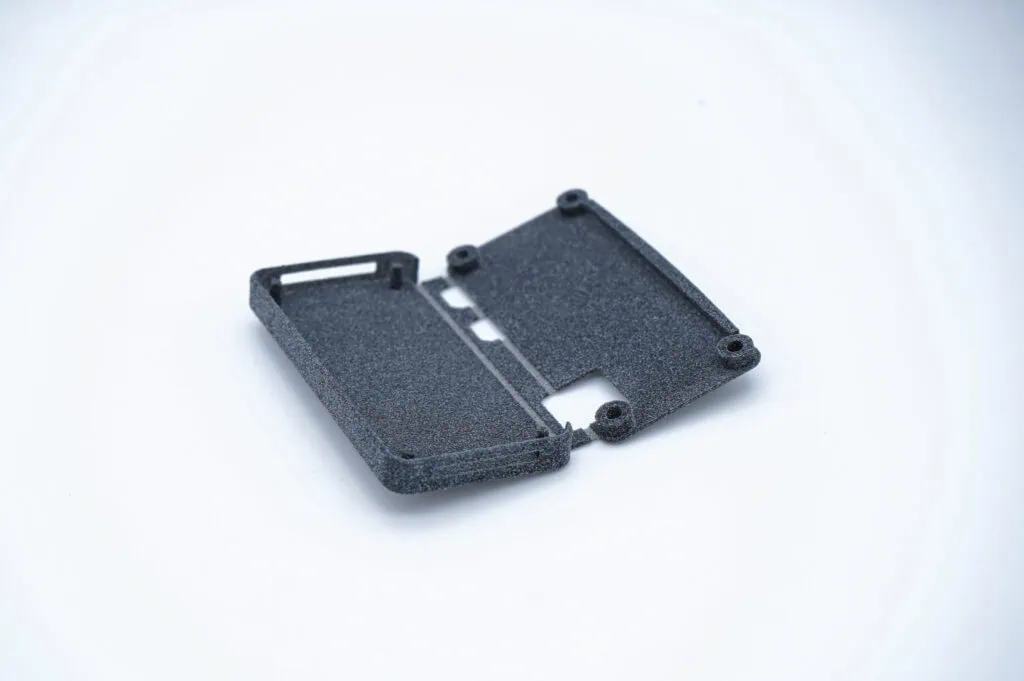
- Snap-ons: Made with flexible materials such as PA12, PA11, or TPU, suitable for casings, covers, and chassis that require frequent opening or replacement, especially excelling in consumer electronics, IoT devices, and sensor housings.
- Movable hinges: Made from stretchable thermoplastic materials (such as resin similar to polypropylene or flexible nylon), hinged lids or flips can be designed directly into parts, suitable for packaging, containers, and access panels.
- Integrated Molding of Movable Joints and Motion Mechanisms: With sufficient gaps, joints, sliders, and hinge components can be printed in one go, allowing movement upon completion. SLS and MJF are especially suitable for this type of self-supporting powder bed printing.
- Integrated clasp or lock housing: no need for mold draft angles or manual insert design—the complex locking system allows direct printing, saving time and simplifying assembly processes.
Compared to CNC machining or injection molding, this approach eliminates the costs of secondary assembly, screws and fasteners, and redesign of insert molds.
4. Easily implement design changes
Updating injection molds can cost thousands of dollars and takes 1–3 weeks. In contrast, changes in 3D printing only require updating the CAD files. This is especially important in the following situations:
- Consumer Product Development: As designs evolve, rapid iteration improves usability and speeds up time-to-market
- Personalized customization: Multiple versions or custom parts need to be made according to the user, such as wearable devices, medical devices, or electronic housings
- Snap-ons or movable hinges: These features can be easily updated in iteration without the need for remolding
- Modular or interlocking systems: More flexible design adjustments, efficiently adapting to different needs
When using 3D printing for mass production, version control and agile product development become feasible solutions. Instead of producing the same part for months, update the design every 200–300 units produced, incorporating user feedback to continuously improve product usability.
5. On-demand production = no inventory costs
3D printing eliminates inventory issues in traditional manufacturing by enabling on-demand production, so only the required parts need to be printed.
With 3D printing, you can produce:
- No storage costs
- No overproduction
- No risk of inventory scrapping
Injection molding typically only has a cost advantage when production exceeds about 10,000 pieces, which often leads to overproduction. In contrast, 3D printing supports distributed and just-in-time production.
6. Abundant materials with production-grade performance
3D printing supports a variety of engineering-grade materials, suitable for final parts in mass production:
| Materials | Compatible technologies | Main performance | Typical applications |
|---|---|---|---|
| Nylon PA12 | SLS, MJF | Strong, durable, and highly stable in size | Housing, gears, brackets, tooling fixtures |
| TPU(如 BASF Ultrasint) | SLS, MJF, FDM | Flexible, wear-resistant, rubber-like feel | Sealing parts, washers, tapes, and soft-touch parts |
| ULTEM 1010 (PEI) | FDM | Flame retardant (UL 94 V-0), high heat resistance | Aerospace air ducts and electrical housings |
| PEEK | FDM | Resistant to chemical corrosion and high-temperature thermoplasticity | Medical implants, high-temperature molds |
| Carbon fiber filled with nylon | FDM, SLS | Lightweight, rigid, and high tensile modulus | Structural parts, drone arms, racing car parts |
| Photosensitive resins (such as transparent, durable, flexible) | SLA, DLP, PolyJet | The surface is smooth, with rich details and partial flexibility | Cosmetic prototypes, small connectors |
| 316L stainless steel | DMLS | It has excellent corrosion resistance and mechanical strength | Food safety tools, marine components, and brackets |
| 铝 AlSi10Mg | DMLS | Lightweight, conductive, and high strength-to-weight ratio | Radiator, casing, lightweight structure |
Comparison of 3D printing with other mass production methods
Still unsure if 3D printing is right for you? The following comparison shows the differences between it in mass production and CNC machining and injection molding.
| Factors | 3D printing | CNC machining | Injection molding |
|---|---|---|---|
| Delivery cycle | 3–7 days | 7–15 days | 4–8 weeks |
| Is mold needed? | None | None | Yes |
| Geometric degrees of freedom | High | Middle | Low |
| Unit Cost (<1k units) | Low | Middle | High |
| Design iteration | Easy | Average | Expensive |
| Minimum yield | 15–10,500 units | 500–1,000 units | — |
| Assembly and integration | Excellent (Clips, Hinges) | Poor | Average |
| Applicable Situations | Small to medium batches, flexible in design and geometry, suitable for iteration or custom parts | It is necessary to machine precise, rigid parts from solid blocks, with simple geometry and strict tolerances | High output of the same part, lowest cost per piece |
Which 3D printing technology is suitable for mass production?
Ready to take the next step? Here are ways to match your manufacturing goals with suitable 3D printing processes.
| Technology | Maximum molding size | Printing speed | Recommended batches | Part quality | Unit cost | Applicable Situations |
|---|---|---|---|---|---|---|
| Multi-jet molten MJF (HP). | 380 × 284 × 380 mm | Fast | 100–1,000 | Very high | Average | Rapid production of functional plastic parts in small to medium batches with good mechanical properties and fine details is required |
| Selective laser sintering of SLS | 340 × 340 × 605 mm | Average | 50–1,000 | High | Average | Strong, isotropic plastic parts are required, with complex geometries and no need for support structures |
| FDM modeling of molten deposition | 900 × 600 × 900 mm | Fast | 1–100 | Average | Low | Used for large sizes or cost-sensitive parts, suitable for internal tools, fixtures, or industrial applications |
| Photocurable stereolithography SLA | 736 × 635 × 533 mm | Average | 1–100 | Excellent | Medium to high | High-resolution or appearance-grade parts are needed for visual models or fine features |
| Direct metal laser sintering DMLS | 400 × 400 × 400 mm | Wait | 10–200 | Excellent | High | Requires low-yield, high-complexity metal parts for aerospace, automotive, or medical applications |
| PolyJet polymerization | 490 × 391 × 200 mm | Average | 1–50 | Excellent | High | Producing small batches, multi-material end parts requires soft touch, color, or transparency |
| Carbon 数字光合成Carbon DLS | 189 × 119 × 300 mm | Fast | 50–500 | High | High | Producing elastic or biocompatible parts suitable for consumer, dental, or medical applications |
Nikolaus Mroncz
Sales Engineering Supervisor
Jetting technologies, such as HP MJF and binder jetting, are among the fastest 3D printing methods—typically, the faster the print, the lower the cost.
Optimization Suggestion: Is 3D Printing Suitable for Mass Production?
Shifting 3D printing from prototyping to mass production requires specific design and process adjustments to ensure consistency, cost-effectiveness, and capacity during mass production.
Here are the optimization methods:
Surface treatment and post-processing
For appearance or customer-facing parts, consider upgrading the surface treatment process:
- Sandblasting treatment: suitable for batch smoothing of SLS or MJF nylon surfaces.
- Steam smoothing: improves surface quality and seals porous structures, enhancing aesthetics and moisture resistance.
- Dyeing or painting: Can be applied during batch post-processing to achieve color consistency and brand effect.
Splitting large parts
For parts exceeding the printed molding size, modular design can be adopted:
- Using mechanical connections, press fits, dovetail joints, or snaps, each part is printed and assembled
- Add positioning features such as protruding tongues or pins to enable precise assembly
Summary and reflection
3D printing is not meant to replace injection molding or CNC machining—it is a powerful complement to them. For mass production of 1 to 1,000 pieces, especially for complex designs or constantly evolving parts, 3D printing offers unparalleled advantages in speed, flexibility, and cost-effectiveness. Engineers can use 3D printing to speed up iterations and reduce production steps.
Want to learn how 3D printing fits your production goals? Upload CAD files to obtain customized quotations for mass production projects.